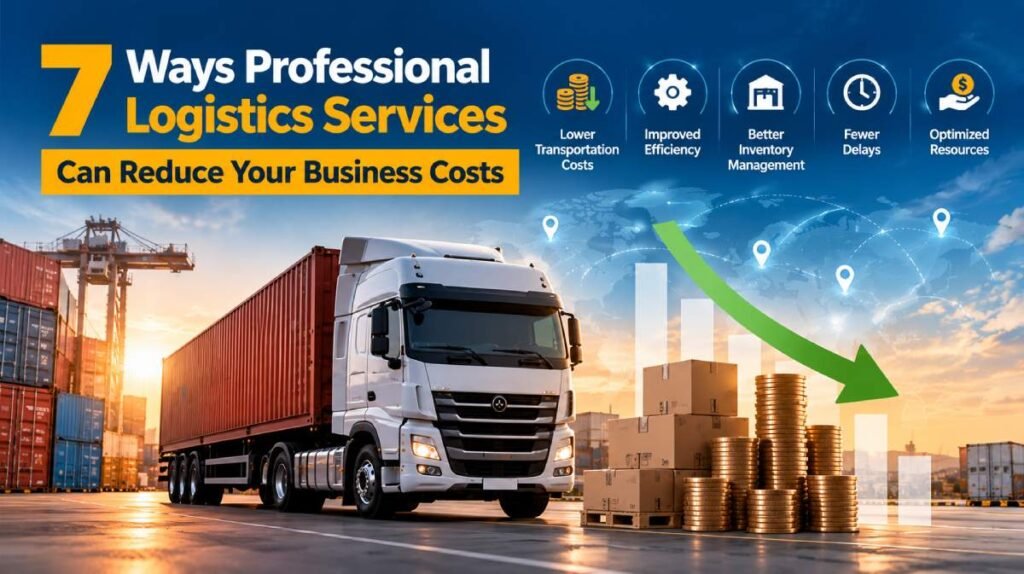
Logistics is one of the biggest operational expenses for many businesses. Transportation, fuel, warehousing, inventory, manpower, delayed deliveries, and inefficient shipment planning can quickly increase operating costs.
For businesses managing logistics internally, even small inefficiencies can add up to significant expenses over time.
This is where professional logistics services can make a major difference.
A reliable logistics partner doesn’t simply move goods from one location to another. With the right processes, technology, transportation network, and expertise, professional logistics services can help businesses reduce unnecessary expenses while improving delivery performance.
Here are 7 ways professional logistics services can help reduce your business costs.
One of the biggest logistics expenses is transportation.
Poor route planning can result in:
Higher fuel consumption
Longer travel distances
Increased driver hours
Vehicle maintenance costs
Unnecessary toll expenses
Delayed deliveries
Professional logistics providers use route planning and optimization techniques to identify more efficient transportation routes.
Instead of relying on fixed or manually planned routes, logistics teams can consider factors such as delivery locations, traffic conditions, vehicle capacity, delivery schedules, and distance.
Sending multiple small shipments separately can be expensive.
Professional logistics providers can consolidate shipments going to similar locations or along similar routes.
For example, instead of sending five partially loaded vehicles separately, shipments may be combined into fewer, better-utilized loads where schedules and delivery requirements allow.
This approach can help reduce:
Shipment consolidation is particularly useful for businesses that regularly transport goods between the same regions or have multiple smaller shipments.
A delayed shipment doesn’t just create a customer-service problem. It can create additional costs throughout your business.
Delays can lead to:
Professional logistics companies have established processes for shipment planning, tracking, dispatching, and exception management.
With better visibility into shipments, potential problems can often be identified earlier.
For example, if a shipment is delayed at one location, the logistics team can take corrective action instead of waiting until the customer reports the problem.
Holding too much inventory ties up capital and increases storage expenses.
At the same time, holding too little inventory can result in stockouts, emergency transportation, and lost sales.
Professional logistics services can support better inventory management through organized warehousing, demand visibility, stock monitoring, and coordinated transportation.
Efficient inventory management can help businesses:
The goal isn’t simply to keep less inventory.
The goal is to maintain the right inventory at the right location at the right time.
Modern logistics relies heavily on technology.
Professional logistics providers may use transportation management systems, shipment tracking platforms, warehouse management systems, GPS tracking, automated notifications, digital proof of delivery, and reporting dashboards.
Technology can reduce the amount of manual work required to manage shipments.
For example, instead of employees repeatedly calling drivers or logistics providers for shipment updates, tracking information can be available through a centralized system.
This can reduce:
Maintaining an in-house transportation fleet can be expensive.
Businesses may need to manage:
Professional logistics providers already have transportation infrastructure and operational resources in place.
Instead of maintaining a large internal fleet, businesses can outsource some or all transportation requirements to a logistics partner.
This can convert many fixed transportation expenses into more flexible operational costs.
It can also reduce the management burden associated with maintaining vehicles and coordinating drivers.
Poor planning often creates expensive last-minute decisions.
For example, a business may suddenly discover that a shipment needs to reach a customer urgently. Instead of using a standard transportation service, the company may have to pay for express transportation or dedicated vehicles.
Emergency logistics can be significantly more expensive than properly planned transportation.
Professional logistics providers can help businesses plan shipments based on:
Better planning allows businesses to make logistics decisions in advance instead of paying premium rates to solve problems at the last minute.
Professional logistics services can do much more than move products from one location to another.
By improving route optimization, shipment consolidation, delivery reliability, inventory management, technology usage, fleet efficiency, and logistics planning, businesses can reduce unnecessary expenses and improve overall operational efficiency.
The biggest savings often don’t come from negotiating a lower transportation rate. They come from eliminating inefficiencies across the entire logistics process.
If your logistics costs are increasing while your shipment volumes continue to grow, it may be time to evaluate your current logistics strategy.
The right logistics partner can help you move more efficiently, reduce operational waste, and control costs — while allowing your business to focus on what it does best: serving customers and growing.
If your business needs dependable transportation, shipment tracking, timely deliveries, and responsive logistics support, choosing the right logistics provider can make your operations significantly more efficient.
Get in touch with our team to discuss your logistics requirements and discover a solution tailored to your business.


Chamba Manali Transport Co.(Regd), for the past 25 years, we have consistently enabled smooth logistics for businesses across India