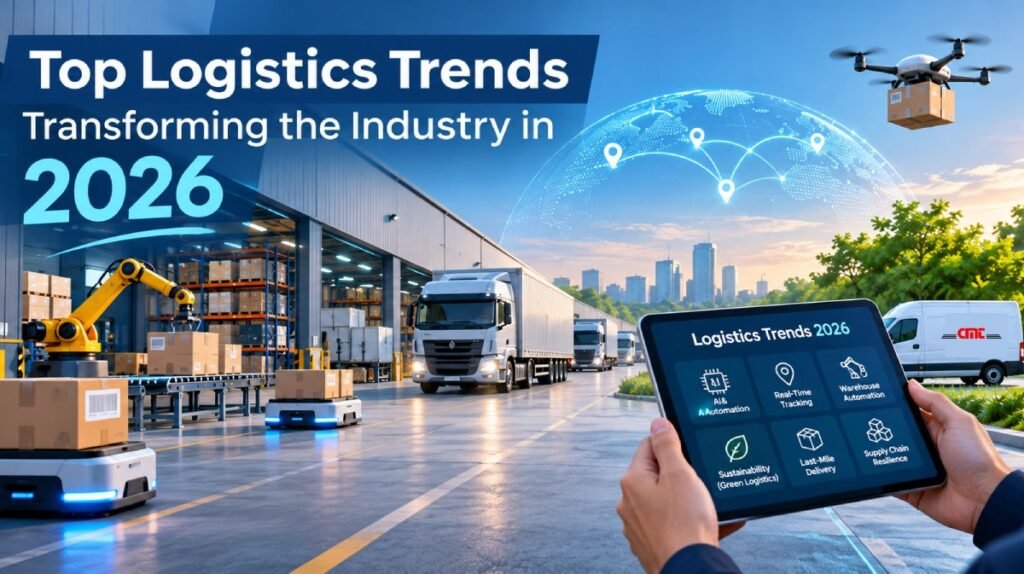
The logistics industry is evolving rapidly in 2026. Advancements in technology, changing customer expectations, rising operational costs, and the demand for faster deliveries are transforming how businesses manage transportation and supply chains.
From Artificial Intelligence (AI) to warehouse automation and real-time shipment tracking, modern logistics solutions are helping businesses improve efficiency, reduce costs, and deliver better customer experiences.
Let’s explore the top logistics trends shaping the industry in 2026.
AI is transforming logistics by helping businesses make smarter and faster decisions. Logistics companies are using AI for route optimization, demand forecasting, delivery predictions, and automated customer support.
AI-powered systems can also identify potential delays and recommend alternative solutions.
Business Benefit: Reduced operational costs, better planning, and improved delivery efficiency.
Customers expect transparency and regular updates about their shipments. GPS tracking, IoT devices, and digital tracking platforms allow businesses to monitor shipments throughout the delivery process.
Modern tracking systems also provide automated notifications, estimated delivery times, and digital proof of delivery.
Business Benefit: Better shipment visibility, fewer customer inquiries, and increased customer trust.
Warehouse automation is helping logistics companies manage inventory and process orders more efficiently.
Technologies such as automated sorting systems, robotic picking, barcode scanning, and warehouse management software are reducing manual work and improving accuracy.
Business Benefit: Faster order processing, fewer errors, and improved warehouse productivity.
Predictive analytics helps logistics companies identify potential problems before they happen.
By analyzing historical data, shipment volumes, traffic conditions, and inventory levels, businesses can forecast demand, plan transportation, and avoid unnecessary delays.
Business Benefit: Better resource planning, reduced disruptions, and improved supply chain efficiency.
Environmental sustainability is becoming an important priority for logistics companies. Businesses are exploring electric delivery vehicles, fuel-efficient transportation, optimized routes, and recyclable packaging.
These initiatives help reduce environmental impact while improving resource utilization.
Business Benefit: Lower fuel consumption, reduced waste, and more sustainable operations.
Last-mile delivery is the final stage of transporting goods to customers. With the growth of e-commerce, businesses are focusing on faster and more reliable delivery services.
Popular developments include same-day delivery, local distribution hubs, flexible delivery scheduling, and automated delivery notifications.
Business Benefit: Improved delivery success rates and better customer satisfaction.
Unexpected disruptions, changing market conditions, and transportation challenges have highlighted the importance of a reliable supply chain.
Businesses are increasingly working with multiple suppliers, exploring alternative transportation routes, and maintaining better inventory visibility.
Business Benefit: Reduced supply chain risks and improved business continuity.
Automation is reducing dependency on repetitive manual processes such as shipment booking, invoice processing, documentation, and delivery updates.
Integrated logistics software can connect transportation, inventory, and order management systems to simplify daily operations.
Business Benefit: Reduced administrative workload, fewer human errors, and improved productivity.
As logistics operations become increasingly digital, protecting business and customer information is essential.
Logistics companies are investing in secure tracking platforms, data encryption, access controls, and regular security monitoring.
Business Benefit: Better data protection, improved customer confidence, and reduced cybersecurity risks.
Businesses are moving towards centralized platforms that connect transportation, warehouse management, inventory, and shipment tracking.
Through software integrations and APIs, information can move automatically between different business systems.
Business Benefit: Better coordination, improved data accuracy, and greater operational visibility.
The logistics industry in 2026 is becoming smarter, faster, and more technology-driven. AI, automation, real-time tracking, predictive analytics, and sustainable transportation are creating new opportunities for businesses to improve supply chain efficiency.
However, technology alone is not enough. Businesses also need reliable logistics partners, efficient processes, and strong operational support.
The future of logistics belongs to businesses that combine technology, innovation, and reliable service to deliver better results.
If your business needs dependable transportation, shipment tracking, timely deliveries, and responsive logistics support, choosing the right logistics provider can make your operations significantly more efficient.
Get in touch with our team to discuss your logistics requirements and discover a solution tailored to your business.


Chamba Manali Transport Co.(Regd), for the past 25 years, we have consistently enabled smooth logistics for businesses across India