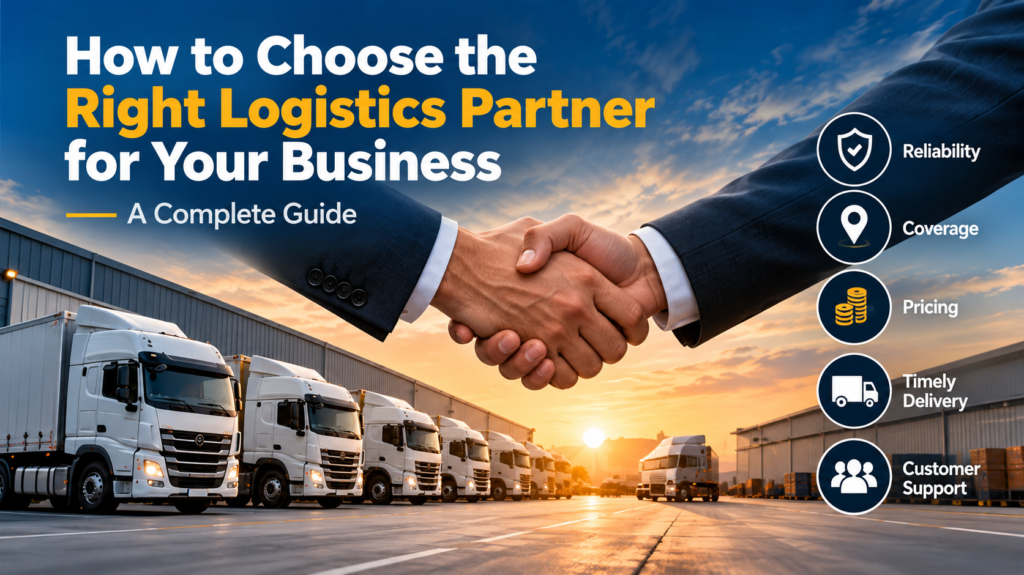
In today’s competitive business environment, logistics is more than simply moving goods from one location to another. It directly affects customer satisfaction, operating costs, cash flow, and your company’s reputation.
Whether you are a growing e-commerce business, manufacturer, distributor, retailer, or enterprise, choosing the right logistics partner can make a significant difference to your operations.
But with so many logistics providers offering different services, pricing models, and delivery networks, how do you choose the right one?
Here are the key factors you should consider before partnering with a logistics company.
Reliability should be one of your top priorities when selecting a logistics partner.
A logistics provider may offer attractive prices, but if shipments are frequently delayed, damaged, or misplaced, the resulting business losses can far outweigh the savings.
Look for a logistics company with:
You should also ask potential partners about their delivery success rate, shipment exception rate, and process for handling lost or damaged shipments.
Remember: Your logistics partner represents your business during the delivery process. Their performance can directly influence how customers perceive your brand.
Your logistics requirements may extend beyond your current service area as your business grows.
Before selecting a logistics partner, check whether their network covers the locations you currently serve and the markets you plan to enter in the future.
Consider:
For businesses operating across multiple locations, a logistics partner with a strong and scalable network can simplify operations and reduce the need to work with multiple providers.
Cost is an important factor, but the cheapest logistics provider is not necessarily the most cost-effective option.
When comparing logistics companies, understand exactly what is included in the quoted price.
Check for additional charges such as:
Fuel surcharges
Pickup charges
Packaging charges
Warehousing fees
COD charges
Remote-area surcharges
Return-to-origin charges
Handling fees
Insurance or liability costs
Instead of simply comparing the lowest shipping rate, calculate the total logistics cost.
A slightly higher shipping price may provide better delivery reliability, tracking, customer service, and fewer failed deliveries — potentially making it more economical in the long run.
Customers today expect visibility into their orders.
A good logistics partner should provide reliable shipment tracking that allows both your business and customers to monitor deliveries.
Look for features such as:
For businesses handling a high volume of shipments, integration with your existing website, ERP, CRM, e-commerce platform, or order management system can make tracking significantly easier.
Better visibility also allows your team to identify delays early and take corrective action before they become customer complaints.
Fast delivery can be an important competitive advantage, but speed should not come at the expense of reliability.
Ask potential logistics partners about their standard delivery timelines and whether they offer different service levels.
Depending on your business requirements, you may need:
Also ask how the company handles unexpected delays caused by weather, traffic, operational issues, or other disruptions.
A dependable logistics partner should provide realistic delivery commitments rather than promising unrealistic timelines.
Even with a strong logistics operation, problems can occasionally occur.
A shipment may be delayed, a delivery address may need correction, or a package may be damaged during transportation. When something goes wrong, you need to know that your logistics partner will respond quickly.
Ask a simple question before signing a contract:
“What happens when there is a delivery problem?”
The answer can tell you a lot about how seriously the logistics provider treats customer service.
Modern logistics depends heavily on technology.
A logistics partner should ideally offer technology that helps you manage shipments efficiently and reduce manual work.
Depending on your business, useful capabilities may include:
Technology becomes particularly important as shipment volumes increase. Manual tracking and coordination may work for a small number of orders, but they can quickly become inefficient as your business scales.
Your logistics requirements today may not be the same six months or two years from now.
Choose a partner capable of growing with your business.
For example, if you currently ship 500 orders per month but expect to reach 5,000 or 10,000 orders, ask whether the logistics provider can handle that increase without compromising service quality.
Discuss:
A scalable logistics partner can help you expand without forcing you to completely redesign your supply chain.
Returns are an important part of logistics, particularly for e-commerce and retail businesses.
Before signing an agreement, understand how the provider manages reverse logistics.
Ask about:
A well-designed returns process can reduce operational costs while improving the customer experience.
Different industries have different logistics requirements.
For example, an e-commerce company may prioritize fast last-mile delivery and returns, while a manufacturer may require bulk transportation, warehousing, and scheduled deliveries.
Ask whether the logistics company has experience handling businesses similar to yours.
Industry experience can help a logistics partner understand your specific challenges and recommend appropriate solutions.
A well-designed returns process can reduce operational costs while improving the customer experience.
Choosing the right logistics partner is an important business decision. The right provider can help you reduce operational complexity, improve delivery performance, control costs, and create a better customer experience.
However, the decision should not be based on price alone.
As logistics companies continue to adopt and adapt, those who embrace change strategically will be the ones leading the future of global supply chains.
If your business needs dependable transportation, shipment tracking, timely deliveries, and responsive logistics support, choosing the right logistics provider can make your operations significantly more efficient.
Get in touch with our team to discuss your logistics requirements and discover a solution tailored to your business.


Chamba Manali Transport Co.(Regd), for the past 25 years, we have consistently enabled smooth logistics for businesses across India